

Hammer Mill Sieves Supplier in Bhutan
Introduction
Welcome to Orion Engineering Works, a leading manufacturer based in the heart of India, (Punjab), Specializing in high-precision pellet dies, press rollers, elevator belts, and buckets. When it comes to pellet mill dies, we pride ourselves on being the best-quality manufacturer in the industry. Orion Engineering Works is dedicated to delivering top-quality components for various industries. With a robust production capacity of over 2800 units annually, we cater to pelleting plants involved in animal feed, minerals, wood products, waste recycling, and beyond.
Hammer mills are widely used in industries where raw materials need to be crushed, ground, or reduced into smaller particles. They are commonly used in feed mills, food processing plants, agricultural industries, biomass processing, chemical industries, and many other manufacturing applications. One of the most important components of a hammer mill is the hammer mill sieve. We are the best Hammer Mill Sieves Manufacturer.
A properly designed sieve helps control the final particle size of the material coming out of the hammer mill. Choosing the right sieve can improve grinding performance, product consistency, machine efficiency, and overall production. Orion Engineering Works offers dependable and application-focused sieving solutions made for various industrial requirements for companies searching for a trustworthy Hammer Mill Sieves Supplier in Bhutan. A high-quality sieve helps control the final particle size, improves grinding efficiency, and supports consistent production. For businesses looking for a dependable Hammer Mill Sieves Supplier in Bhutan, choosing the right manufacturer and supplier is essential.
What Are Hammer Mill Sieves
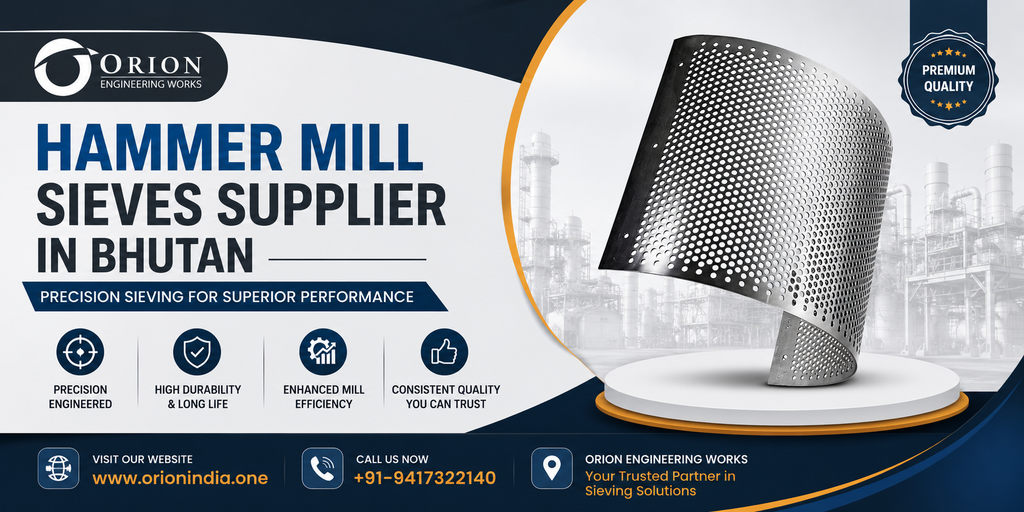
Hammer mill sieves, also called hammer mill screens, are perforated sheets fitted inside a hammer mill. During the grinding process, the material is hit by rotating hammers. The particles continue to be reduced in size until they are small enough to pass through the openings in the sieve. Because the sieve directly affects the grinding process, it is important to use a properly manufactured and durable screen. We are the best Hammer Mill Sieves Exporter.
The ground material passes through the openings in the sieve once it reaches the required particle size. The size and shape of these openings directly influence the final output. Hammer mill sieves are available with different hole diameters, thicknesses, and configurations. The appropriate sieve depends on the material being processed, required particle size, production capacity, and type of hammer mill.
Importance of Hammer Mill Sieves
A sieve may appear to be a simple component, but it plays a major role in hammer mill performance.
- Controlling final particle size
- Supporting consistent grinding
- Improving product uniformity
- Helping maintain production efficiency
- Reducing the possibility of oversized particles
- Supporting smooth material flow
- Improving the overall grinding process
Using an unsuitable sieve can affect production quality and may increase wear on other hammer mill components. Therefore, selecting the right sieve is important for efficient operation.
Types of Hammer Mill Sieves
1. Perforated Hammer Mill Sieves
- Perforated sieves are among the most commonly used screens in hammer mills. They are manufactured with accurately positioned holes that allow processed material to pass through. These sieves are suitable for applications where uniform particle sizing is required.
2. Round Hole Hammer Mill Sieves
- Round-hole sieves have circular openings and are widely used for general grinding applications. The hole diameter can be selected according to the required output size. They are commonly used for agricultural products, grains, animal feed, and various other materials.
3. Slotted Hammer Mill Sieves
- Slotted sieves have elongated openings instead of traditional round holes. They can be useful for specific materials and applications where controlled material flow is required. The slot dimensions can be selected according to the machine and processing requirements.
4. Fine Mesh Hammer Mill Sieves
- Fine sieves are designed for applications where smaller particle sizes are required. They are used when the final product needs to have a fine and consistent texture. Fine screens are commonly used in food processing, chemical processing, and certain agricultural applications.
5. Heavy-Duty Hammer Mill Sieves
- Heavy-duty sieves are manufactured for demanding industrial applications. They are designed to handle materials that can cause higher wear during grinding. These screens are suitable for continuous production environments where durability and reliable performance are important.
Applications of Hammer Mill Sieves
1. Animal Feed Production
- One of the major applications of hammer mill sieves is animal feed production. Grains such as maize, wheat, barley, sorghum, and other feed ingredients need to be reduced to a suitable particle size before mixing and pellet production. The sieve helps control the final grinding size. Different feed formulations may require different particle sizes, so interchangeable screens allow the same hammer mill to process materials according to specific production requirements. Proper particle size can also support good feed mixing and digestibility.
2. Poultry Feed Manufacturing
- Poultry feed manufacturers use hammer mills to grind grains and other raw materials into uniform particles. Hammer mill sieves are particularly useful because the perforation size can be selected according to the desired fineness. A properly selected sieve can help produce consistent material for subsequent mixing and pelletizing operations. This is especially important where uniform feed quality is required across production batches.
3. Cattle and Livestock Feed
- Hammer mill sieves are also used for preparing feed ingredients for cattle, buffaloes, goats, sheep, and other livestock. Materials such as maize, grains, pulses, and agricultural by-products can be processed into smaller particles. By selecting an appropriate sieve opening, manufacturers can control the output size and adjust the grinding process according to the feed formulation.
4. Fish Feed Production
- Fish feed requires carefully controlled particle sizes, particularly when ingredients are subsequently used in pellet or extruded feed production. Hammer mills equipped with suitable sieves can grind ingredients into a relatively uniform size before further processing. This makes hammer mill screens useful in aquafeed manufacturing where consistent raw material preparation is important. Hammer mills are widely used for aquafeed and pet-food ingredient size reduction.
5. Grain Milling
- Agricultural grains can be processed using hammer mills for different applications. Wheat, maize, barley, sorghum, and other grains can be reduced into smaller particles for feed, food processing, or other industrial uses. The sieve determines the maximum particle size able to exit the grinding chamber. Therefore, changing the screen provides flexibility when different grinding requirements are involved.
6. Spice Grinding
- Hammer mills can also be used for grinding dried spices and similar materials. Products such as dried chilli, pepper, coriander, and other dry ingredients may require size reduction before packaging or further processing. Hammer mill sieves help achieve the required level of fineness. A finer screen can generally retain material longer in the grinding chamber, while a larger opening allows material to pass through more easily.
7. Biomass Processing
- Biomass is another important application for hammer mills. Agricultural residues, wood chips, straw, husks, and other biomass materials can be reduced in size before being used for pellet production, energy generation, or other processing applications. Screen opening is one of the important factors affecting the resulting particle size. Research on biomass grinding has shown that screen opening and hammer operating conditions can significantly influence particle-size distribution.
8. Wood and Sawdust Processing
- Hammer mill sieves are used in wood-processing applications where wood chips, shavings, sawdust, and other wood materials need to be reduced to a defined size. Ground wood may be used for pelletising, wood flour production, drying processes, or energy applications. The required screen depends on the raw material and target particle size.
9. Organic Fertiliser Production
- Organic fertiliser manufacturers can use hammer mills to reduce agricultural and organic materials into smaller particles. Materials may include dried plant residues, organic waste, and other suitable feedstocks. The sieve helps regulate the output size, making the ground material more suitable for mixing, processing, and subsequent fertiliser production.
10. Agricultural Waste Processing
- Agricultural waste such as crop residues, husks, stalks, and other dry by-products can be processed through hammer mills. Reducing the size of these materials can make them easier to handle and prepare for further utilisation. Depending on the intended application, the processed material may be used in animal feed, biomass fuel, composting, or other value-added processes.
Benefits of Using Quality Hammer Mill Sieves
1. Consistent Particle Size
- One of the biggest advantages of a quality hammer mill sieve is better control over particle size. The diameter and design of the sieve openings determine the maximum size of particles that can leave the grinding chamber. Smaller openings generally produce finer material, while larger openings allow comparatively coarse material to pass through. A reliable Hammer Mill Sieves Supplier in Bhutan can provide different hole sizes according to the required application, helping businesses achieve a more consistent finished product.
2. Improved Grinding Efficiency
- The correct sieve allows properly ground particles to exit the mill while keeping oversized particles inside for additional impact. This helps the hammer mill perform its intended size-reduction process efficiently. Sieve selection should be matched with the material, desired particle size, rotor speed, and operating conditions. Research has shown that screen size can significantly influence both particle-size distribution and grinding performance.
3. Better Production Quality
- In applications such as grain processing and animal feed production, particle size consistency can be important for the quality of the final product. A properly selected sieve helps maintain the required grinding specification and reduces the possibility of oversized particles entering the finished material. For this reason, businesses looking for a Hammer Mill Sieves Supplier in Bhutan should consider suppliers that can provide accurately manufactured and application-specific sieve plates.
4. Wide Range of Hole Sizes
- Different industries require different levels of grinding. A good hammer mill sieve supplier can offer a variety of aperture sizes and perforation patterns. For example, finer openings may be selected when a powder-like output is required, while larger openings can be suitable for coarse grinding. Changing the sieve is one of the practical ways to adjust the finished particle size of a hammer mill.
5. Durable Construction
- Hammer mill sieves operate in a demanding environment where they are exposed to continuous impact and abrasive material flow. High-quality materials and accurate manufacturing can help the sieve withstand these operating conditions. Perforated screens are commonly manufactured from materials such as carbon steel, stainless steel, and wear-resistant grades depending on the application.
6. Reduced Machine Downtime
- A damaged, worn, or clogged sieve can affect grinding performance and production. Worn holes can become enlarged, allowing particles larger than the intended size to pass through, while clogged openings can restrict material flow. Keeping suitable replacement sieves available can help maintenance teams replace worn components quickly and reduce unnecessary production interruptions.
7. Suitable for Different Materials
- Hammer mills are used for processing many types of materials, including grains, agricultural products, biomass, food ingredients, and other materials suitable for impact grinding. The required sieve specification can vary according to the material and desired output. A professional Hammer Mill Sieves Supplier in Bhutan can help customers select suitable perforation sizes based on the material being processed and the required final particle size.
8. Better Control Over Fineness
- Particle fineness is an important requirement in many milling applications. A sieve with appropriately selected openings provides better control over the maximum particle size leaving the grinding chamber. This makes sieve selection particularly important when manufacturers need repeatable output from batch to batch. The screen aperture acts as a physical limit on the particle size that can leave the grinding chamber.
9. Custom Manufacturing Options
- Not every hammer mill does not necessarily use the same sieve dimensions. Machines can differ in screen shape, thickness, diameter, mounting arrangement, and perforation requirements. A dependable Hammer Mill Sieves Supplier in Bhutan can offer standard as well as customised sieve solutions based on machine requirements. Custom sizing can be especially useful when replacement screens need to match existing equipment.
10. Cost-Effective Replacement
- Replacing an individual sieve can be a practical maintenance solution compared with allowing a worn screen to negatively affect the entire milling process. Properly manufactured replacement sieves can help restore the desired grinding performance without requiring replacement of the complete hammer mill. Regular inspection and timely replacement are useful for maintaining consistent particle size and avoiding unexpected production problems.
Why Choose Orion Engineering Works
1. High-Quality Hammer Mill Sieves
- A reliable supplier focuses on manufacturing hammer mill sieves with accurate dimensions, uniform perforations, and suitable material strength. Quality is important because the sieve works continuously in an environment involving impact, friction, and material movement. A properly manufactured sieve can provide stable performance and help reduce problems caused by uneven or poorly formed openings. Consistent hole dimensions also support more predictable particle sizing.
2. Accurate Particle Size Control
- One of the main reasons to choose a professional Hammer Mill Sieves Supplier in Bhutan is better control over the final particle size. The perforation size of a hammer mill sieve influences the size of particles that can leave the grinding chamber. Generally, smaller openings are used when finer material is required, while larger openings allow comparatively coarser material to pass through.
3. Durable Construction
- Hammer mill sieves must withstand continuous operation and repeated contact with processed materials. Depending on the application, different grades of steel or other suitable materials can be considered. For general industrial applications, carbon steel can be a practical option, while stainless steel may be preferred where corrosion resistance and hygiene are important. Wear-resistant materials can be considered for abrasive applications.
4. Different Hole Sizes and Patterns
- Hammer mill sieves are available with different opening sizes and patterns depending on the material and desired output. Round holes are widely used for general screening, while slotted or other opening designs can be suitable for specific materials. A knowledgeable supplier can help buyers select the appropriate configuration rather than simply supplying a standard product.
5. Better Grinding Efficiency
- The sieve is an important part of the grinding process because it determines when material can leave the grinding chamber. If the sieve is correctly selected, material can be processed to the desired size before discharge. A suitable combination of hammer condition, screen opening, feed characteristics, and operating conditions can contribute to stable grinding performance.
6. Consistent Product Quality
- For manufacturers, consistency is just as important as production speed. Variations in particle size can affect the quality and performance of the final product. A correctly designed hammer mill sieve helps control the material leaving the grinding chamber. This can support more consistent particle-size distribution, which is particularly valuable in feed, biomass, agricultural, and food-processing applications.
7. Reduced Maintenance and Downtime
- A damaged, worn, or incorrectly selected sieve can affect mill performance. Excessive wear may change the effective opening size, while unsuitable openings can contribute to reduced capacity or unwanted particle sizes. Choosing a properly manufactured replacement sieve can help businesses maintain their equipment more effectively. Regular inspection is also important because sieve condition directly affects grinding performance.
8. Cost-Effective Long-Term Solution
- The cheapest sieve is not always the most economical option. A low-quality component may wear faster, provide inconsistent sizing, or require more frequent replacement. A properly manufactured hammer mill sieve can provide better long-term value by combining suitable material strength, accurate perforation, correct dimensions, and dependable performance.
9. Improved Production Capacity
- Sieve design can also affect production capacity. A higher effective opening area can allow material to pass through more efficiently when the sieve is correctly matched to the process. However, the sieve must always be selected according to the material and required particle size rather than simply choosing the largest opening. Working with an experienced supplier helps manufacturers find the right balance between particle-size requirements, durability, and production output.
10. Custom Sieve Solutions
- Every hammer mill application is not the same. Different machines may require different dimensions, mounting arrangements, hole patterns, or aperture sizes. This is why it is beneficial to choose a supplier that can provide customised solutions. A supplier with technical knowledge can understand the customer’s hammer mill specifications and recommend a suitable sieve instead of offering only standard products.
11. Reduced Machine Downtime
- A damaged or worn sieve can affect the performance of a hammer mill and may interrupt production. Keeping suitable replacement sieves available can help reduce unnecessary downtime. A reliable Hammer Mill Sieves Supplier in Bhutan can support businesses with replacement components and help them select the correct sieve before ordering. This is particularly valuable for production facilities where continuous operation is important.
Conclusion
Hammer mill sieves are an essential part of grinding equipment because they help control the final particle size and support consistent material processing. Selecting the right sieve can contribute to better grinding performance, improved product consistency, and efficient machine operation. We are the best Hammer Mill Sieves Exporter in Punjab.
For companies searching for a dependable Hammer Mill Sieves Supplier in Bhutan, Orion Engineering Works offers reliable solutions for various industrial applications. Whether you require sieves for agriculture, animal feed, biomass, food processing, chemical processing, or other suitable hammer mill applications, selecting the correct specifications is essential for achieving the desired results.